Seven key security trends in 2017 according to GFI Software
The growing volume of fake news, ransomware and credential theft will prompt many organizations to strengthen specific areas of IT security
PRAGUE, January 9, 2017 – According to GFI Software, a provider of security solutions for enterprise networks, 2017 in enterprise IT security will continue the trends of the previous year, which can be considered groundbreaking in many respects. The sharp rise in ransomware, theft of email account credentials and the use of fake news to achieve political and business objectives will lead many organizations to strengthen specific segments of IT security.
Here are the 7 key security trends that GFI Software sees as crucial this year:
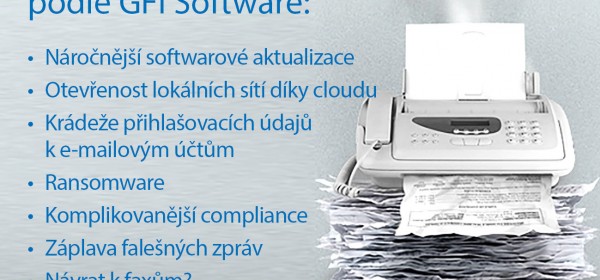
- More demanding software updates. Last year, Microsoft changed the approach to security updates in its operating systems towards greater cumulative updates. In many cases, this means more work and stress for IT administrators and a higher level of risk for systems if a highly cumulative update fails. Businesses can no longer do without systems for network auditing and update management.
- The openness of local networks due to the cloud. While cloud security itself is no longer the primary concern that used to be the main obstacle to the development of cloud services, more intensive use of the cloud leads to a greater degree of connectivity between local networks and the Internet, which will require better endpoint protection.
- Theft of email account credentials. Although social media is beginning to dominate private communication, email remains irreplaceable in the corporate sphere. The case from May 2016, when access data for 270 million email accounts was stolen, could easily happen again this year.
- Ransomware. In 2017, the number of ransomware attacks will continue to grow, for example increasingly using the almost forgotten method of attacks via macros in Microsoft Office files contained in email spam. Here, as in the previous case, enterprise email security will need to be strengthened.
- More complicated compliance. The current IT security situation will lead to increasingly complex regulatory requirements and force businesses to implement more sophisticated solutions with logging and reporting capabilities.
- A flood of fake news. Just as last year, we expect a number of political events this year that will be accompanied by a flood of fake news, which can become easy bait for inexperienced users and a major threat to the companies where they work. Never before have web monitoring solutions been more necessary than they will be in 2017.
- A return to fax machines? Due to the growing uncertainty about the origin of the information bombarding us, many organizations (especially in the public sector) are nostalgically looking at outdated fax technology as an old, reliable and secure communication tool – without the risk of malware infection, encryption or data theft.
“Although the deployment of secure fax communication is understandable and purposeful for many government organizations, we are not convinced that fax machines will return to the commercial sphere,” said Zdeněk Bínek, responsible for sales of GFI Software solutions in the Czech and Slovak markets. “To eliminate the security threats of 2017, businesses should instead focus on protecting the key IT tools that maximize productivity – namely email, web access and endpoint devices.”
Article author: ZEBR.ai editorial team