

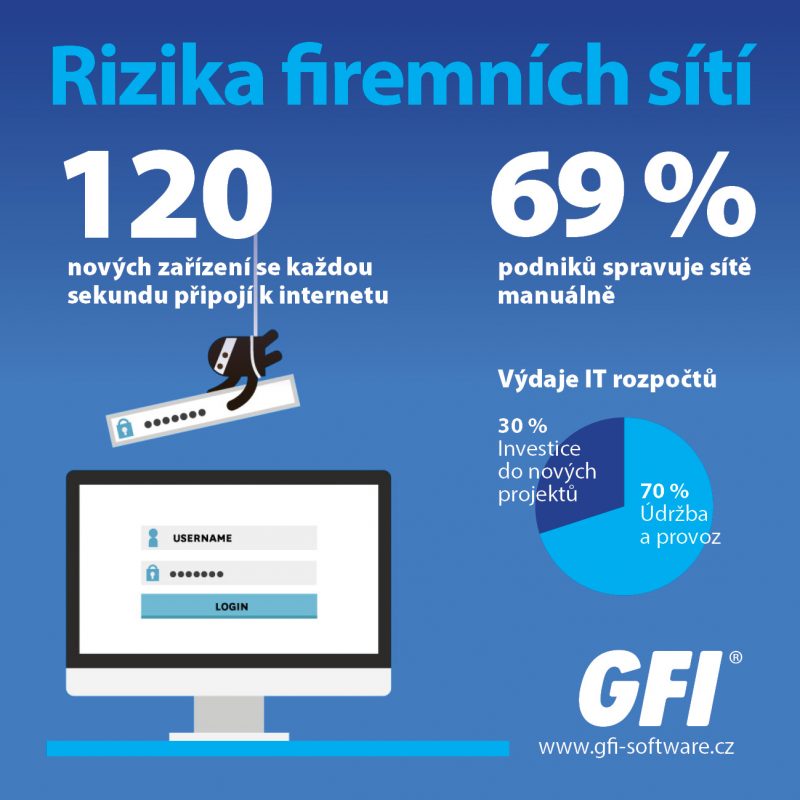
More than 120 new devices connect to the internet worldwide every second
PRAGUE, September 26, 2019 – GFI Software, a provider of security solutions for enterprise networks, stated that the expansion and increasing complexity of corporate computer networks often lead to a decline in business productivity and competitiveness. The growing number of devices and applications on networks increases demands on network throughput and security, and if organizations do not improve their networks, they risk failures resulting in operational and financial losses. A Forrester study shows that most companies spend around 70% of their IT budget on maintaining and operating existing systems, while only 30% is invested in new projects.
More than 120 devices newly connect to the internet every second, and there will be more than 20 billion IoT devices on the internet alone by 2020. The consequence of this growth is an increasing number of components that can fail in such a complex network. The main network issues that can have a fundamental impact on an organization include:
- Weak security – One of the most common causes of network issues is security, or rather a lack of security. According to the Ponemon Institute, two-thirds of all network breaches are caused by security gaps, human errors, and negligence.
- Configuration changes – When adding or removing devices from the network, introducing new functionalities, migrating systems, or making substantial changes to existing applications, changes occur to the network and its configuration, which can lead to reduced performance and integrity.
- Manual management – Manual management and interventions, inefficient network procedures and processes, and an incomplete overview of network operation and performance can reduce innovation and competitiveness. A Veriflow study shows that 69% of organizations rely on manually performed processes.
- Lack of prioritization of key applications – Video applications such as Netflix or YouTube can consume a substantial portion of an organization's transmission capacity. Critical applications then take longer to launch or freeze completely. The result: data loss, lost productivity, frustrated users.
“IT administrators and information managers today face the task of meeting the more demanding requirements of business users for IT performance while maintaining the integrity of their increasingly complex networks,” said Zdeněk Bínek, responsible for GFI Software sales in the Czech Republic and Slovakia. “They can now identify and resolve current issues in their corporate networks with the help of tools for continuous traffic evaluation, automated scanning, and prioritization of important business applications.”
GFI Software offers organizations the Exinda Network Orchestrator solution, which enables businesses to understand network and application traffic within their infrastructure so that they can easily and proactively allocate internet bandwidth to critical applications to ensure the required performance. The GFI LanGuard tool, in turn, provides automated update management, vulnerability scanning on computers and mobile devices, and network and software auditing. To enhance security, it makes it possible to create an inventory of the assets of every device on the network, including tablets and smartphones. GFI LanGuard is also part of the GFI Unlimited licensing model, enabling the use of up to 10 GFI Software products under a cost-effective, single subscription.
Article author: ZEBR.ai editorial team



