Many companies have recently found themselves in a situation where most of their employees had to start working remotely – with all the consequences that entails. One of them is the technical security of IT infrastructures with a changed topology, which creates strong pressure on IT administrators and managed service providers (MSPs) responsible for the continuity and security of technology support. Ensuring support for users outside the office requires a comprehensive approach and tools to eliminate various risks.
Shared devices, unsecured routers…
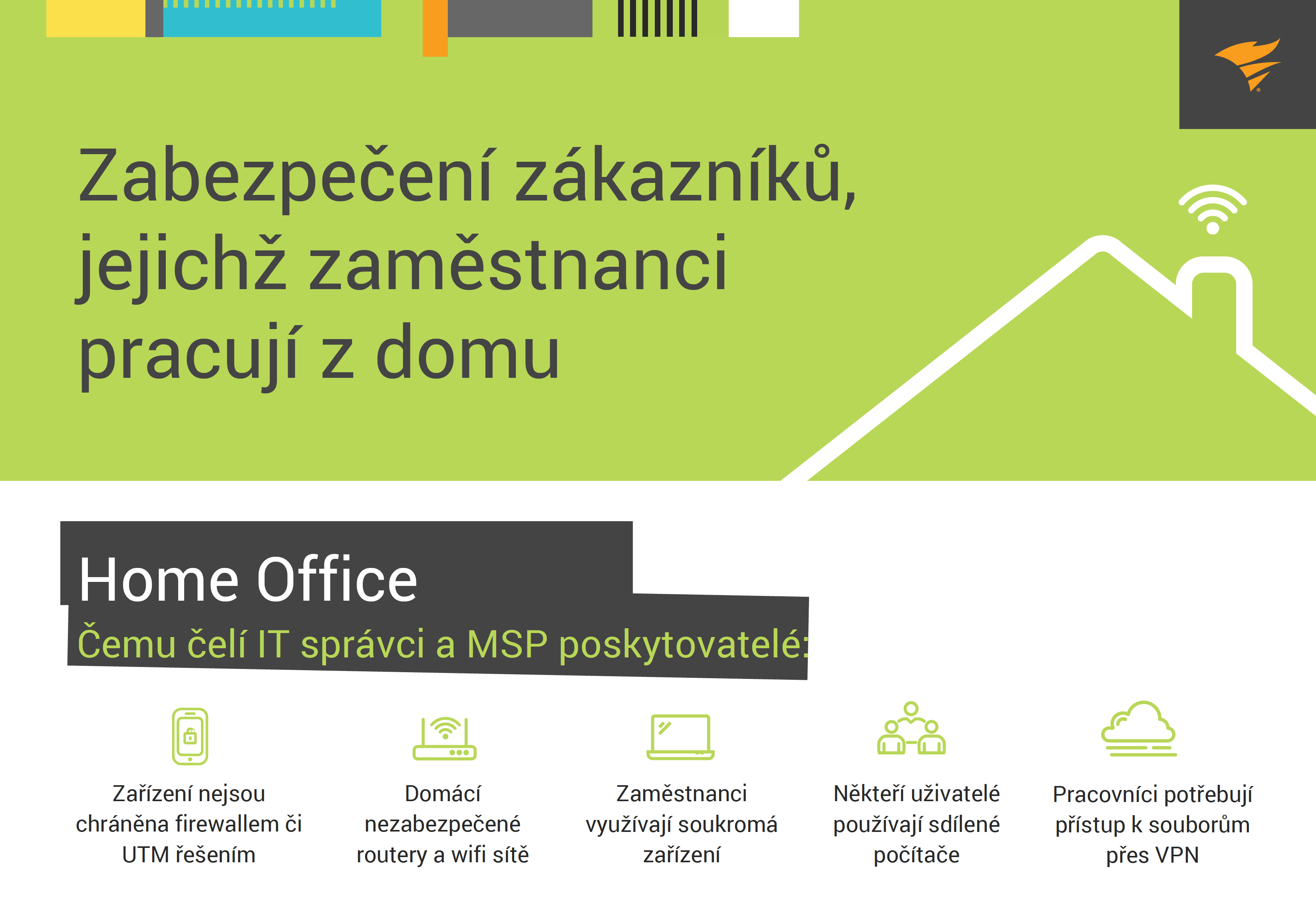
Once an employee works from home, IT administrators need to address several issues. The first is the fact that devices are not protected by a corporate firewall or an integrated threat management (UTM) solution. Another weak point is inexpensive home routers and internet gateways without any security. At home, users use their personal devices and some even share them with other family members. Many users also need access to work files located on the corporate infrastructure via a VPN connection.
What risks arise from these facts? Devices that users use for work are more susceptible to infection or data theft as a result of infected emails, websites and outdated software. However, other risky devices on the home network, such as unsecured IoT devices or another computer, can also cause problems. In addition, home Wi-Fi is a highly unpredictable environment with easily guessed passwords, factory-default router access and other vulnerabilities.
Once a home user works from a private device, the important security layer of email filtering disappears, increasing the risk of an attack through an infected attachment. They generally do not use secure backup either, so newly created data exists in only one copy on the home device. If IT administrators do not have agents installed on private devices, they lose visibility into the infrastructure in use, which can lead to the loss of important corporate data.
A comprehensive RMM solution
IT administrators and managed service providers are therefore turning to remote monitoring and management (RMM) platforms, especially now. Among the most widely used platforms are solutions from the SolarWinds MSP portfolio, primarily SolarWinds Remote Monitoring and Management (RMM). This centralized set of management and remote monitoring tools with cloud management is intended primarily for smaller and emerging MSP providers. SolarWinds N-central is designed for larger, established MSP organizations.
SolarWinds RMM provides professional IT administrators with all the tools necessary for remote network management, identifying bottlenecks, preventing cyberattacks, reporting and many other activities in a multi-tenant mode. Thanks to experience with hundreds of thousands of networks and millions of endpoints, this platform offers solutions to problems even before an infrastructure outage occurs.
From the perspective of working from home, the following SolarWinds RMM functionalities are particularly important for MSP providers:
- Endpoint Protection – provides protection for endpoint devices against malware and other threats
- Patch Management – offers a highly automated way of updating software on user computers
- Web Protection – protects users from visiting compromised websites that can damage the network and connected devices
- Remote Monitoring – easy monitoring of workstations, network devices and mobile devices from a unified console
- Backup & Recovery – file backup and rapid recovery in the event of loss
- Email Security – securing email communication, including ensuring business continuity and archiving
- Mobile Device Management – monitoring, updating and inventorying corporate and private mobile devices
- Remote Access – rapid resolution of user requests to repair any workstation
- Password Management – ensures secure access using strong user passwords
- Reporting – generating the reports needed for better decision-making and compelling presentation of benefits to customers
Working from home will likely remain an important element of how companies operate in today's market. IT administrators will have to adapt and become more flexible and productive. With SolarWinds RMM as a managed services platform, they can respond quickly to changes and serve a greater number of customers from one central console.
Štěpán Bínek, Product Manager Cloud Services, Zebra systems
The article was published in Computerworld magazine, 9/2020
Article author: ZEBR.ai editorial team