The regular Acronis Cyberthreats Report has published data collected during the first half of 2024
PRAGUE, July 30, 2024 – Acronis, a global leader in cybersecurity and data protection, today released new research findings from the first half of 2024 in its semi-annual cyberthreat report. The Acronis Cyberthreats Report H1 2024 uses data from more than one million unique endpoints worldwide to provide insight into global cybersecurity trends. The latest report found that email attacks increased by 293% compared with the same period in 2023. The number of detected ransomware attacks also grew, rising by 32% from Q4 2023 to Q1 2024.
Ransomware continues to pose a major threat to small and medium-sized businesses (SMBs), especially in critical sectors such as government and healthcare. In Q1 2024, Acronis recorded 10 new ransomware groups that collectively claimed 84 cyberattacks worldwide. Among the 10 most active ransomware families identified during this period, three particularly highly active groups stand out, collectively accounting for 35% of attacks: LockBit, Black Basta and PLAY.
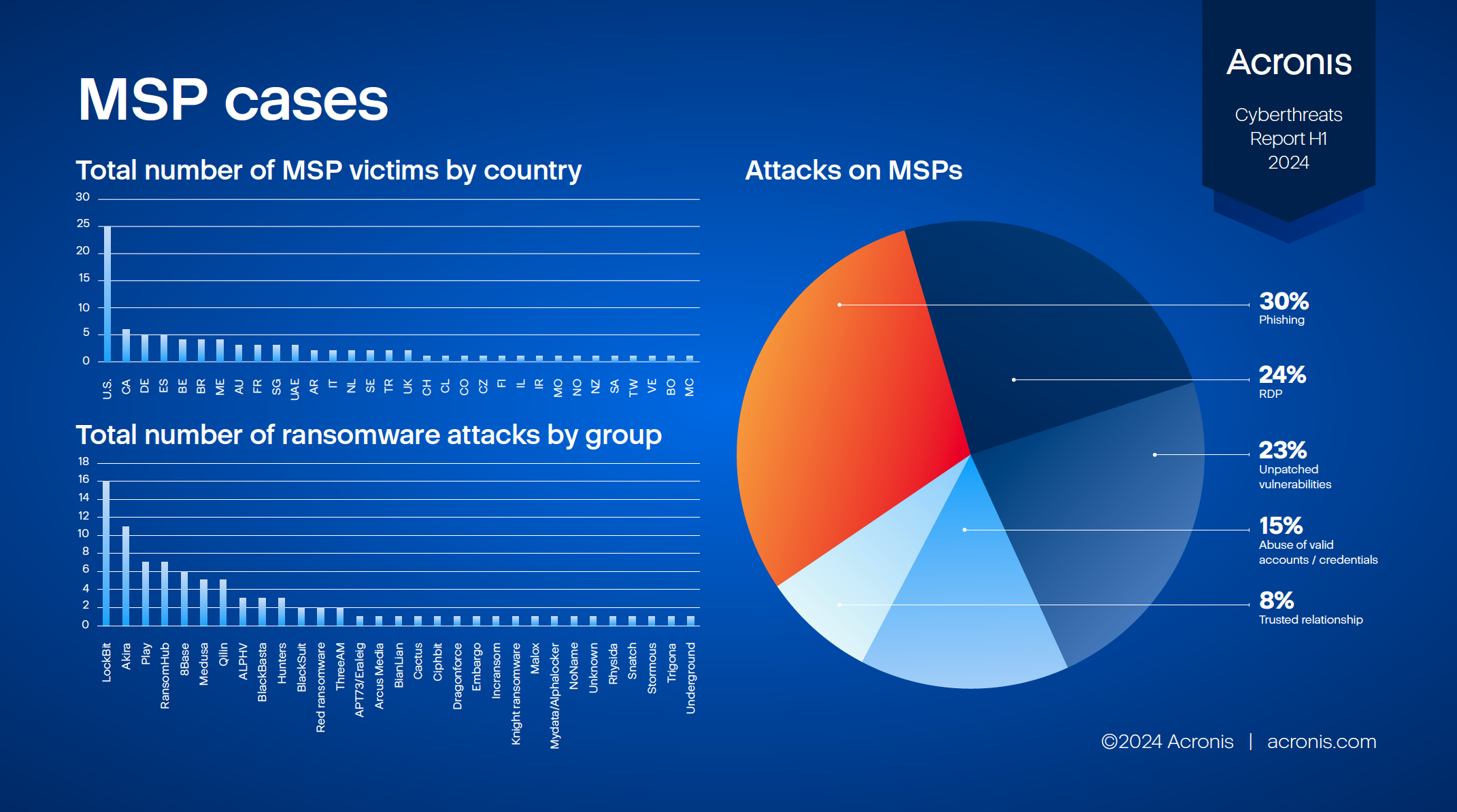
The report particularly notes how managed service providers (MSPs) are being targeted and compromised. Phishing and social engineering, vulnerability exploitation, credential abuse and supply chain attacks were identified as the most successful techniques used to breach MSP cybersecurity defenses.
“As a result of the growing volume and complexity of cyberthreats that we continue to uncover in today’s cybersecurity landscape, it is critically important for MSPs to take a systematic approach to securing their customers’ data, systems and digital infrastructures,” said Irina Artioli, report author and cyber protection expert in the Acronis Threat Research Unit division. “To be effective, we recommend that MSPs adopt a comprehensive security strategy, including mandatory security threat training and incident response planning. They should also deploy advanced endpoint protection solutions, such as extended detection and response (XDR), multi-factor authentication and more.”
In addition, the report focuses on emerging cybersecurity trends and highlights the growing use of generative artificial intelligence (AI) and large language models (LLMs). Specifically, it emphasizes AI used in social engineering attacks and automation. The most common AI-generated attacks include malicious emails, business email compromise (BEC) deepfake scams, deepfake extortion, KYC verification bypasses, and script and malware generation.
Other key findings from the report include:
Email communications
– Organizations experienced a sharp increase in email communications, with the number of emails per organization rising by 25%.
– The number of email attacks detected in the first half of 2024 increased by 293% compared with the first half of 2023.
– 27.6% of all received emails were spam, and 1.5% contained malware or phishing links.
Ransomware
– In Q1 2024, 28 million URLs were blocked on monitored endpoints.
– In Q1 2024, 1,048 ransomware cases were publicly reported, representing a 23% increase compared with Q1 2023.
– In the first quarter of 2024, Acronis researchers recorded 10 new ransomware groups that collectively claimed 84 cyberattacks worldwide.
– The number of ransomware detections increased by 32% from Q4 2023 to Q1 2024.
Attacks on MSPs
– Attacks on MSPs continued steadily from January to May 2024, with data revealing that attackers most often used email phishing campaigns.
– Phishing attacks accounted for 30% of all attacks, attacks via Remote Desktop Protocol (RDP) for 24%, unpatched vulnerabilities for 23%, and credential abuse for 15%.
– 26% of users encountered phishing attempts using malicious URLs.
AI-powered attacks
– Cybercriminals continue to use malicious AI tools such as WormGPT and FraudGPT.
– Artificial intelligence can help attackers at every stage of a cyberattack, but it can also be used as a defense mechanism because it enables continuous attack detection and reports attacks to security experts, who can respond with appropriate measures to ensure business continuity.
For more information, download a copy of the full report Acronis H1 2024 Cyberthreats Report here.
Further information about the report and its findings is available on the Acronis blog.
Article author: ZEBR.ai editorial team